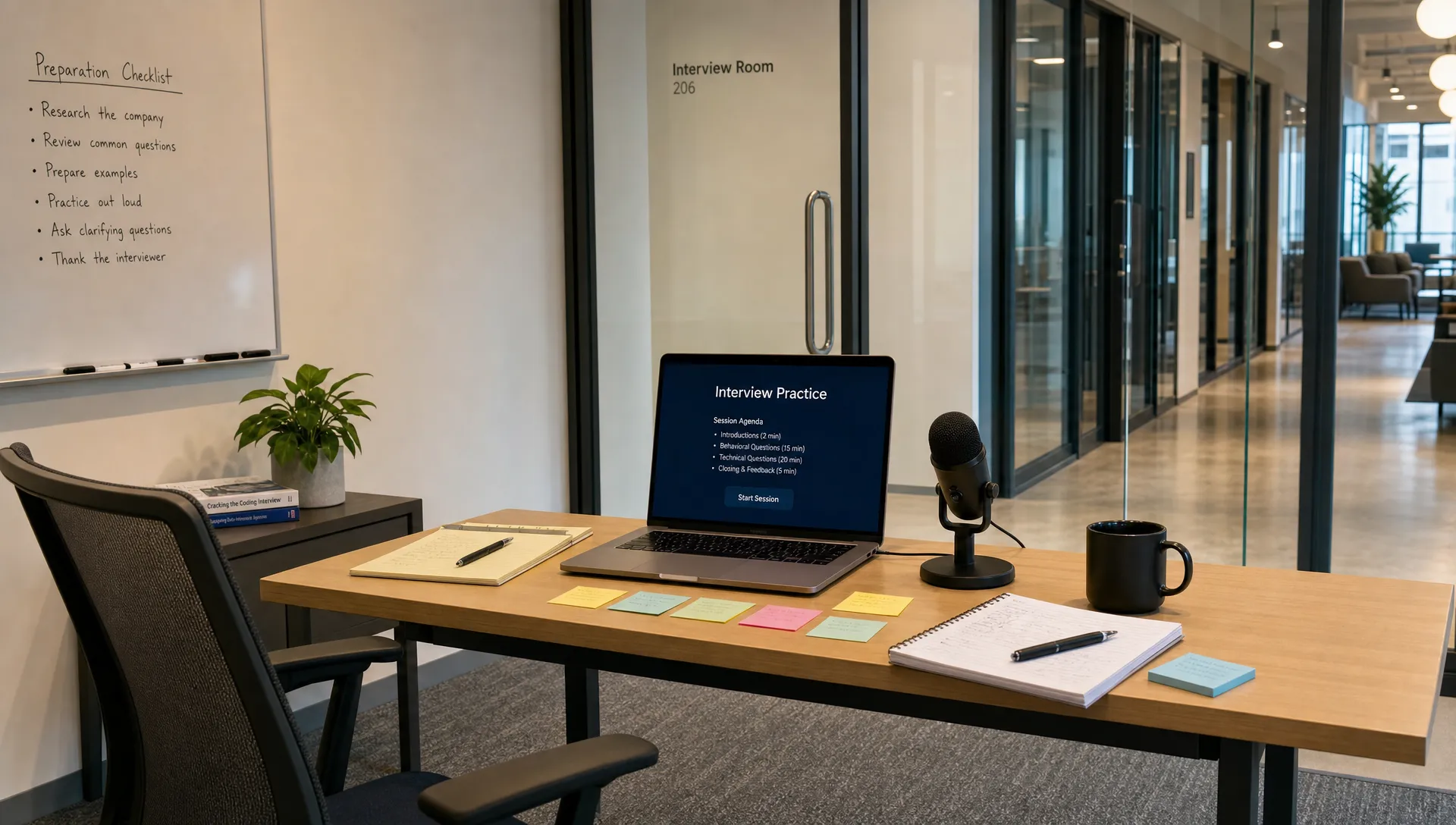
Real confidence before an interview is not the same as feeling fearless. You can feel nervous and still be ready. Good job interview advice should help you reduce uncertainty, organize your evidence and practice under conditions that feel close to the real conversation.
If you have ever read a list of tips and still felt unprepared, the problem probably was not you. Many interview tips sound reasonable but do not create proof that you can handle the moment. The 15 tips below are designed to build confidence because each one gives you something practical to rehearse, check or improve before the interview.
Why Most Job Interview Advice Fails to Build Confidence
Generic guidance often focuses on surface signals: sit up straight, dress well, make eye contact and send a thank-you note. Those details matter, but they do not solve the deeper problem. Candidates usually feel uncertain because they do not know what they will be asked, how strong their examples are or whether their answers sound convincing out loud.
Confidence comes from three sources: clarity about what the interviewer cares about, stories that prove you can do the work and enough realistic practice to make those stories feel natural. The U.S. Department of Labor's CareerOneStop interview tips also emphasizes preparation, examples and follow-up, which is the right foundation. The difference here is that every tip is tied to confidence, not just interview etiquette.
15 Tips That Actually Build Interview Confidence
1. Define the risk the interviewer is trying to reduce
An interview is not a performance where you recite impressive facts about yourself. It is a risk assessment. The hiring team is trying to answer questions like: Can this person do the work, collaborate with the team, learn quickly and stay motivated after the novelty wears off?
Before you prepare answers, write down the top three risks a hiring manager might see in your profile. Maybe you are changing industries, stepping into a bigger role or returning after a break. Once you name the risk, you can prepare evidence that addresses it directly.
2. Turn the job description into a question map
The best job interview advice becomes useful when it turns a vague task into something specific. Read the job description line by line and convert each major requirement into a likely interview question.
For example, if the role asks for stakeholder management, prepare for questions about conflict, prioritization and communication. If it asks for ownership, expect questions about ambiguity and missed goals. Your question map should cover:
- Skills the role requires every week
- Situations the person will likely face in the first 90 days
- Evidence that proves you have done similar work before
This reduces anxiety because you stop preparing for every possible question and start preparing for the questions that are most likely to matter.
3. Build a bank of six proof stories
Most candidates overprepare introductions and underprepare evidence. A better approach is to build a small story bank you can adapt to many prompts.
Aim for six stories: one achievement, one conflict, one failure, one leadership moment, one technical or role-specific challenge and one example of learning quickly. Each story should have a clear situation, action and result, but it should not sound like a script.
| Story type | What it proves | Questions it can answer |
|---|---|---|
| Achievement | You can create measurable value | Tell me about a win, why should we hire you |
| Conflict | You can handle tension professionally | Describe a difficult coworker, how do you give feedback |
| Failure | You can learn without defensiveness | Tell me about a mistake, what would you do differently |
| Ambiguity | You can operate without perfect instructions | Tell me about a time you had little direction |
| Learning | You can ramp up quickly | How do you handle new tools, industries or responsibilities |
4. Practice answers out loud, not in your head
Thinking through an answer is useful, but it does not train your voice, pacing or transitions. Many candidates feel prepared until they hear themselves ramble for three minutes.
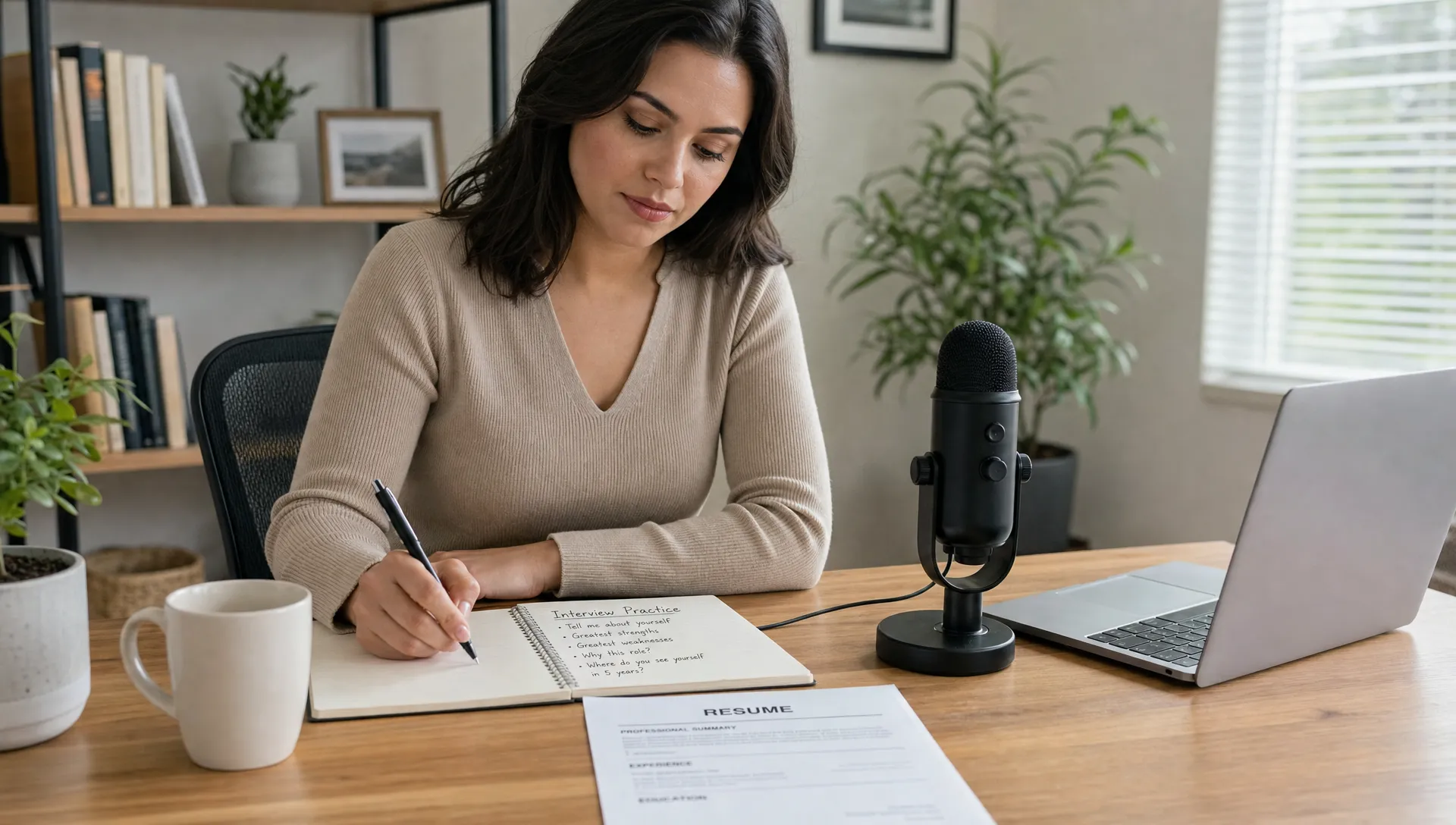
The most practical job interview advice for confidence is to practice out loud before the stakes are real. Say your answers in full sentences. Notice where you lose structure, where you sound too abstract and where you need a stronger ending. If you want a realistic environment, voice-based mock interviews can help you practice live answers with role-specific follow-up questions instead of silently rehearsing alone.
5. Use STAR without sounding robotic
The STAR method is popular because it gives behavioral answers a clean shape: situation, task, action and result. The problem is that some candidates turn it into a stiff formula.
Use STAR as a checklist, not a script. Start with just enough context for the interviewer to understand the stakes. Spend most of your time on the action you personally took. End with the result and one sentence about what you learned. If the result was not perfect, explain the lesson and what changed afterward.
6. Prepare a strong answer to why this role
Job interview advice often says to research the company, but confidence comes from connecting that research to your own motivation. A strong why this role answer should link three things: the company's needs, the work you want to do and the evidence that you are ready for it.
Avoid vague praise like the company seems innovative or I like the culture. Instead, mention a product, customer problem, market move or team goal that genuinely interests you. Then connect it to work you have done before. This makes your motivation sound grounded rather than performative.
7. Record one practice session and listen for only three things
Recording yourself can feel uncomfortable, but it is one of the fastest ways to improve. Do not listen for every flaw. That will make you self-conscious and less confident.
Listen for three things only: whether your answer has a clear point, whether your example is specific and whether your ending lands. If you fix those three issues, you will sound more prepared than most candidates. Keep the recording private and treat it like game film, not a judgment of your personality.
8. Prepare for follow-up questions
Real interviews rarely move in a straight line. A hiring manager may ask what you would do differently, how you measured success or how your teammate reacted. If you have only memorized a first answer, a follow-up can make you freeze.
After each proof story, write three possible follow-ups. Then practice answering them briefly. You do not need a perfect response to every angle. You need enough flexibility to show that your example is real and that you understand the tradeoffs behind it.
9. Create a calm opening ritual
The first two minutes of an interview can shape how you feel for the rest of the conversation. Build a simple ritual you can repeat before every interview: check your setup, breathe slowly, review your three strongest stories and remind yourself of the role's main needs.
For virtual interviews, join early enough to test audio and camera, but do not spend the extra time rereading every note. For in-person interviews, arrive with enough margin that you are not negotiating traffic, parking or security at the last second.
10. Prepare concise answers for weak spots
Honest job interview advice should include the uncomfortable parts of your profile. Maybe you have a resume gap, a short tenure, a layoff, a lower GPA, a career pivot or limited experience with one tool in the job description.
Do not overexplain. A strong answer has three parts: acknowledge the fact, give brief context and redirect to evidence. For example, if you lack a specific tool, you might say you have not used that platform in production yet, but you have used similar systems and can describe how you ramped up quickly in a past role.
11. Ask questions that prove judgment
Your questions are part of the interview. They show what you notice, how you think and whether you understand the role beyond the job title.
Ask about success measures, team priorities, decision-making and the problems the new hire will inherit. Questions like what would make someone highly successful in the first six months or which part of the role tends to surprise new hires can give you useful information while also signaling maturity.
Do not use questions only to impress. Use them to decide whether the role is right for you.
12. Bring numbers, but do not force them
Job interview advice becomes weaker when it tells every candidate to quantify everything. Numbers are powerful when they are honest and relevant. They are distracting when they feel inflated or unrelated to the role.
If you can quantify revenue, cost savings, time saved, customer growth, error reduction or speed improvements, do it. If you cannot, use concrete scope instead: size of team, number of stakeholders, frequency of the task, complexity of the environment or level of ownership. Specificity builds credibility even when the result is not a neat percentage.
13. Practice company-specific versions of your best answers
A great answer for one company may sound generic at another. Once you have your core stories, adapt them to the company's product, industry, values and likely challenges.
For example, a project management story can emphasize speed at a startup, compliance in healthcare or cross-functional alignment at a large enterprise. The story is the same, but the framing changes. If you need structure for this kind of preparation, Roundpass also keeps a library of interview preparation guides that can help you organize practice by interview stage and goal.
14. Use feedback without surrendering your voice
Modern job interview advice should include feedback loops, especially because candidates now have access to AI practice tools, transcripts and performance analytics. Feedback can help you notice patterns you would miss on your own, such as answers that are too long, vague or missing results.
Still, the goal is not to sound like a machine-generated ideal candidate. Use feedback to make your real experience clearer. Keep your natural phrasing where it works. Replace only the parts that confuse the listener, bury the point or fail to answer the question.
15. Stop preparing at the right time
More preparation is not always better. The night before an interview is not the time to rewrite every answer. That usually creates new anxiety.
Set a stopping point. Review the role, your story bank, your questions and the logistics. Then stop. Sleep, eat normally and give your brain space to consolidate what you practiced. Confidence grows when your preparation feels complete, not when you chase one more perfect answer.
A Simple Practice Plan for the Final 72 Hours
To make this job interview advice easier to apply, use a short practice plan instead of cramming randomly. Three days before the interview, build your question map and proof story bank. Two days before, practice out loud and record one session. One day before, review weak spots, company-specific framing and the questions you want to ask.
On the day of the interview, do not start from scratch. Warm up with your introduction, your why this role answer and one proof story. If you want a fast rehearsal, you can also start a mock interview in under a minute and use the session to practice speaking clearly before the real conversation.
This structure gives your confidence somewhere to come from. You are not hoping to feel ready. You are proving to yourself that you have prepared for the parts of the interview you can control.
Frequently Asked Questions
How can I feel more confident before a job interview? The most useful job interview advice is to prepare evidence, not just answers. Build a few strong stories, practice out loud and prepare for follow-up questions so you know you can handle a real conversation.
Should I memorize my interview answers? No. Memorized answers often sound stiff and can break down when the interviewer asks a follow-up. Memorize the structure and key points instead, then practice saying the answer naturally.
How long should I practice for an interview? For most interviews, several focused sessions are better than one long cram session. Spend time mapping likely questions, practicing aloud, reviewing feedback and adapting your strongest examples to the company.
What should I do if I freeze during an interview? Pause, breathe and restate the question in your own words. It is acceptable to say you want a moment to think. Then answer with a simple structure: context, action and result.
Can AI mock interviews help build confidence? Yes, if you use them as practice rather than a script generator. Realistic voice practice, follow-up questions, transcripts and feedback can help you notice what to improve before the stakes are higher.
Build Confidence with a Realistic Practice Interview
Reading tips helps, but speaking under realistic conditions builds stronger interview confidence. Roundpass helps you practice voice-first mock interviews tailored to your role, company and resume, then review feedback, transcripts and performance signals after the session.
Practice with Roundpass
Start practicing with Roundpass
Practice voice-first mock interviews and get feedback before the real interview.
Try freeRoundpass runs in your browser with voice-based mock interviews. Your first session is free.